Editor:
Layne Larsen
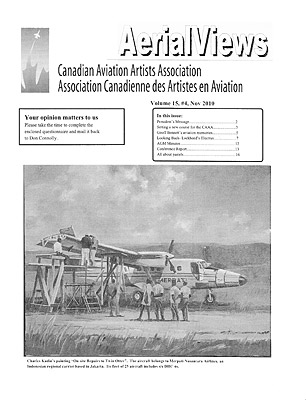
Each
issue includes:
- Latest CAAA news from across Canada;
- Members' Gallery feature;
- Artist profiles;
- Articles by members on technique; and
- Aviation news items.
Membership
contribution is most welcome and encouraged!
Sample Technique Articles
Aerial
Views article excerpt:
Looking Back... An Under-rated Fighter?
.....by Layne Larsen
 |
| Painting by Charles Thompson |
Ask
any WW II history buff which aircraft he most closely associates with
the Battle of Britain, and the most likely answer will be “Spitfire”.
While not incorrect, that answer is not quite on the mark. As will
be shown below, it is not without good reason that the RAF’s
annual Battle of Britain flypast is led by a Hawker Hurricane.
In 1933, Sydney Camm, Hawker’s chief designer, began de-sign
of what he called the Fury monoplane which would be pow-ered by the
Rolls-Royce Goshawk, carry four guns, have a closed cockpit and a
revolutionary retractable undercarriage. By early 1934, his design
had been renamed the ‘Interceptor Monoplane”, would carry
eight guns and be Merlin powered, although the Fury lineage is still
obvious. In Aug 1934, the Air Ministry wrote specification F36/34
around Camm’s design, and authorized the construction of one
prototype, K5083, which had its maiden flight on 06 Nov 1935. In June
1936, it was formally named Hurricane and in Dec 1937, the first production
aircraft reached operational service with 111 Squadron.
When Camm undertook his design, he was aware that Supermarine, (working
to specification F37/34 which would become the Spitfire), had much
more experience with stressed-skin, monocoque monoplanes and would
put most of its emphasis on performance. He therefore decided to capitalize
on Hawker’s production experience with the Fury and Hart, and
design an aircraft that would meet the performance specification,
but would be rugged, simple, fast and inexpensive to produce and quick
and easy to repair and maintain.
Camm’s decision paid dividends for the RAF. Although the contracts
for the two aircraft were awarded only a month apart, the gap slipped
to four months between maiden flights, and to six months for entry
into squadron service. For the same expenditure of resources, Hawker
was able to produce five Hurricanes for every three Spitfires. Thus,
on 8 Aug 1940, the official onset date for the Battle of Britain,
and despite losing nearly 200 Hurricanes in the Battle of France,
the RAF could muster 32 squadrons of Hurricanes and only 19 of Spitfires.
The Hurricane, although it was a little slower and could not climb
as fast as either the Spitfire or Bf-109, had several unique qualities/advantages
over its RAF stablemate:
• As noted above, it was cheaper, easier and faster to build,
maintain and repair. Throughout the war, it had the highest serviceability
rate of any RAF aircraft despite the often appalling operating conditions.
• It had a superior ability to withstand combat damage and still
fly, fight and get its pilot home safely.
• Its sloping nose and slightly elevated pilot seating provided
superior forward visibility both during taxiing and flight, and in
tight turns, the nose did not blank out the target.
• Its rugged, wide-track undercarriage enabled it to operate
from rougher fields and to withstand hard landings without collapsing
or ground-looping.
• It had superior manoeuvreability to both the Spitfire and
Bf-109, easily turning inside them.
• It was also superior to both as a gun platform.
Robert Stanford Tuck, in his biography “Fly for Your Life”
by Larry Fisher, stated that he was heartbroken to be transferred
from his beloved Spitfire to a Hurricane unit, but went on to say:
“After the Spit, she was like a flying brick....a great lumbering
farmyard stallion compared with a gentle thoroughbred....[but]....after
that first hop, after I’d got the feel of her, I never noticed
this, or any of the other differences any more.”.
Douglas Bader, who also transitioned from Spitfires to Hurri-canes,
in his book “Fight for the Sky”, said:
“Like all pilots who flew and fought in the Hurricane, I grew
to love it. The Spit was a somewhat better performer, but when it
came to actually shooting, the Hurricane had no equals. In a dogfight,
the Hurricane was every bit as good as the Spitfire.”.
He and many other pilots believed that the Hurricane’s stability
as a gun platform came from its thick, straight wing and the close
clustering of the guns just outside the propellor arc. Whereas the
Spitfire jittered when in the target’s slipstream, and the recoil
from its widely spaced guns tended to throw off one’s aim, the
Hurricane was as steady as if it was riding on rails.
From the moment the two aircraft were introduced into RAF service,
Spitfire pilots tended to look down their noses at those who were
‘unfortunate’ enough to get stuck with Hurricanes. It
is interesting to note that even Luftwaffe aircrew suffered from “Spitfire
snobbery” They had been led to believe that the Spitfire was
much the superior aircraft, and after being shot down and captured,
insisted that they could only have been bested by a Spitfire rather
than the lowly Hurricane.
A similar snobbery is evident in the apocryphal story of a conversation
between Hermann Goring and Adolf Galland. The former, supposedly,
asked the latter what he needed to win the Battle of Britain, and
the reply was “A wing of Spitfires”. During that Battle,
Hurricanes actually accounted for more enemy aircraft than all other
air defences combined. Perhaps, if that exchange ever actually took
place, Galland should have asked for a wing of Hurricanes.
Although Hurricanes were directed primarily against bombers, while
the Spitfires went after the covering fighters, in practice, the
situation was much more fluid. When engaged in fighter-vs-fighter
combat, the Hurricane had only a marginally lower ‘kill ratio’
than the Spitfire; however, the Hurricane pilot had a better chance
of surviving being shot down.
Altogether, some 14,251 Hurricanes were built, including a large number
by Canadian Car and Foundry. They served in every theatre in which
Commonwealth forces were engaged, including with the RCAF in Canada.
Although withdrawn from UK-based Fighter Command units in late 1941,
it soldiered on in front-line service in other theatres until the
end of the war. It was employed as a fighter, fighter-bomber, tank-destroyer
(when fitted with two underwing 40 mm cannon), photo reconnaissance,
from aircraft carriers (as the Sea Hurricane) and was even catapulted
off merchant vessels (CAM ships) for convoy protection against air
attack.
While the Spitfire was extensively developed and modified during its
service to enhance its performance, the Hurricane was not. Although
progressively more powerful versions of the Merlin were installed,
the airframe remained basically unchanged. There were 12 marks, and
several sub-models; however, these largely defined where they were
built, armament fit, or which Merlin variant was installed.
Hurricanes were supplied to more than a dozen other coun-tries, including
2952 (although not all arrived due to losses on convoys) to the USSR,
and at least 30 Soviet pilots became aces flying this aircraft. The
only Victoria Cross won in Fighter Command was by Hurricane pilot
J. B. Nicholson on 17 Aug 1940 who, despite being wounded, his aircraft
badly damaged and on fire, pressed home his attack on a Bf-110, destroyed
it, and parachuted to safety.
Suffice it to say, that without the contribution of this often under-rated
aircraft, the Battle of Britain would have been lost and who knows
what the world might look like today!
Visit
our Hurricane
Tribute Gallery!
YOU'LL SEE MORE STORIES LIKE THIS IN YOUR MEMBER'S COPY OF AERIALVIEWS!